


June 2015 · Film Photography · Taipei, Taiwan
After returning to Taiwan from Canada, the first thing I searched for wasn’t food, friends, or even home.
It was a film lab.
In the digital age, finding a place that still develops analog film feels a little like searching for a forgotten bookstore or an old record shop — quietly disappearing, one by one.
I remember walking through streets near Guanqian Road in Taipei, scanning signs above storefronts, hoping to spot the familiar words: film developing, negatives, prints.
When I finally found one, I felt oddly relieved.
They told me I could pick up the photos in just a few hours.
A few hours.
Not instant.
Not immediate.
Not now.
And somehow, that delay felt comforting.
I still had one unfinished roll of black-and-white film inside my camera.
A few exposures left.
So instead of going home, I wandered around the neighborhood, casually looking for something — anything — to finish the roll.
No pressure.
No expectations.
Just walking.
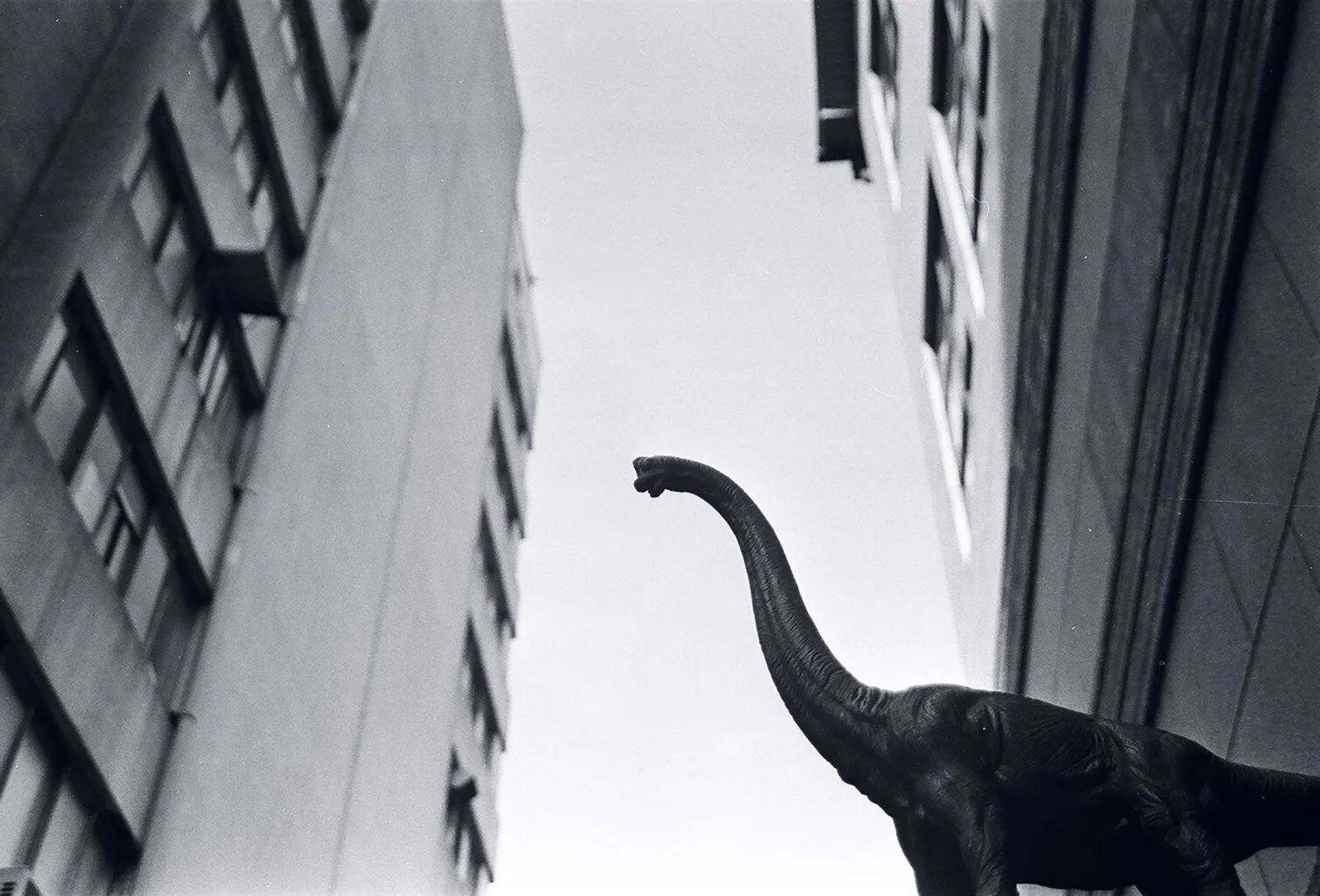
Right outside the shop’s back entrance, I noticed it.
A small dinosaur sculpture mounted near what looked like the back door of a museum.
It was nothing spectacular.
Not a famous landmark.
Not even particularly detailed.
Just a small, slightly cute dinosaur figure.
Almost toy-like.
But something about it made me smile.
Maybe it was the way it stretched its neck upward.
Maybe it was the contrast between something prehistoric and the modern concrete around it.
Instinctively, I stepped back and looked up.
Tall buildings rose on both sides, creating a narrow canyon of sky.
From this angle, the tiny dinosaur suddenly didn’t look tiny anymore.
It looked enormous.
As if it had quietly wandered out of the Jurassic period and gotten lost in Taipei.
For a second, reality and imagination overlapped.
A small sculpture became a giant creature.
A city alley became a prehistoric landscape.
It felt playful. Surreal. Slightly absurd.
I framed the shot and pressed the shutter.
Click.
The last frame of the roll.
Then came the waiting.
I hadn’t felt that kind of anticipation in a long time.
With digital photography, everything is immediate.
Shoot. Check. Delete. Adjust. Repeat.
There’s no mystery.
No space for imagination.
But film is different.
You don’t know if the exposure worked.
You don’t know if the composition holds.
You don’t even know if the moment exists the way you remember it.
You simply wait.
And waiting, I realized, is a form of trust.
A few hours later, I returned to the shop.
The photos were still slightly warm when they handed them to me.
That warmth — straight from the machine — is something digital files will never have.
I couldn’t even wait to get home.
I walked into a nearby café, ordered a drink, and slowly flipped through the prints one by one.
Each image felt physical. Tangible. Real.
Then I saw this frame.
The dinosaur.
Small, yet monumental.
Fragile, yet powerful.
Standing between cold, geometric buildings like a quiet rebellion of imagination.
I laughed softly to myself.
It looked better than I expected.
Better than I remembered.
In that moment, I understood something simple but important.
Digital speed often turns anticipation into anxiety.
We want results immediately.
We refresh.
We compare.
We judge.
But film teaches the opposite.
It teaches patience.
It teaches surrender.
It teaches you to replace anxiety with expectation.
Not “Did it work?”
But “I wonder what it became.”
That tiny dinosaur in Taipei didn’t just finish my roll of film.
It reminded me how I want to experience life.
Less rushing.
Less checking.
More waiting.
More trusting.
More childlike wonder.
Sometimes, even a small dinosaur can become a giant —
if you just look up.
This is what film photography Taipei means to me:
not just documenting a city, but rediscovering curiosity inside it.